Advantages of Dry Coating in the Battery Industry with Slot Die Coating Technology
In the pursuit of higher energy density lithium-ion and next-generation batteries, the field is shifting rapidly toward thick, high-mass-loading electrodes, a challenge that conventional wet coating struggles to meet. The recent work “Sustainable and cost-effective electrode manufacturing for advanced lithium batteries: the roll-to-roll dry coating process” (Park et al., 2025) makes a compelling case for replacing wet slurry coating with roll-to-roll dry coating. Find that technical resource, referred to in our article as “The Technical Review” here: RSC Publishing
Dry coating demands even more precise control over the deposition process and is inherently challenging. This complex process offers core advantages in battery manufacturing and can be best accomplished by integrating several precision technologies including slot die coating and extrusion technologies. Combining the precision of slot die with the efficiency of roll-to-roll manufacturing is the most precise and efficient way to develop the next-generation battery technology.
A Summary of The Technical Review Highlights the Promise and Challenges of Roll-to-Roll Dry Coating
› Eliminating solvent-related drawbacks in thick electrodes
The review points out that the current most widely used technology, wet slurry coating, becomes problematic when electrode thickness grows. During the drying step, solvent evaporation causes binder migration leading to inhomogeneous microstructure. This means there can be uneven distribution of binder, active particles, and conductive additives. This condition tends to worsen for thick electrodes (e.g., ~200 µm), degrading ionic/electrical pathways and reducing performance.
› Sustainability & cost benefits
Dry coating removes the need for toxic organic solvents, reduces energy consumption (no solvent drying ovens), lowers environmental footprint, and can cut production costs materially compared with wet processes.
› Mechanical integrity via binder fibrillization
In roll-to-roll dry coating, the polymer binder (commonly Polytetrafluoroethylene, PTFE) is fibrillized. This means that shear forces during the rolling/extrusion process stretch and reorganize PTFE particles into a porous, fibrous network. This network provides mechanical cohesion, structural integrity, and uniform distribution of active materials, conductive additives, and binder. The structural integrity of the network is crucial for performance in thick electrodes.
› Scalability and industrial viability
The review argues that roll-to-roll dry coating is among the most scalable and cost-effective approaches for next-generation lithium, lithium-metal, lithium-sulfur, or solid-state battery systems.
These strengths make roll-to-roll dry coating a powerful alternative to wet-slurry processes. The complexity of the dry coating process can make the up-front development hurdle a challenge for companies. Research and development needs to include a team with the scientific, technical, and process knowledge to develop a successful and powerful finished product. You may be surprised to that the best place to find those specific skills is to look to those experienced in slot die coating technology.
Where Slot Die Precision Still Matters, and Why
Even though dry coating replaces the liquid-slurry + drying sequence, the process remains a coating operation. That means many of the same underlying demands and risks apply including uniform film formation, consistent layer thickness, careful control of material flow and web dynamics, and scaling up from lab to roll-to-roll production.
Here’s how slot die coating and high-precision slot dies remain essential in battery manufacturing:
• Pre-metered, highly controllable deposition
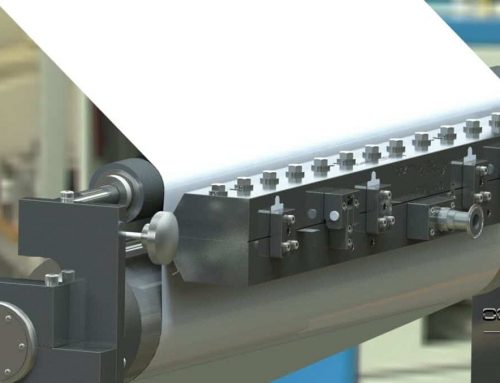
In slot die coating, the wet (or in this case dry-mixed/fibrillized) “ink” is delivered through a precisely engineered narrow slit (the slot die) onto a moving substrate. The coating thickness (or more broadly, mass-per-area) is determined by the ratio of volumetric flow rate to substrate speed and die width in a pre-metered system that lends itself to predictable scaling and reproducibility.
For dry coating, this means that even if material is brought in a dry, shear-mixed form, the slot die geometry, flow control, and motion synchronization are critical to ensure uniform layer formation and avoid defects.
• Uniformity across wide webs and long runs (roll-to-roll ready)
Slot die coating is widely adopted in roll-to-roll manufacturing because it reliably and precisely delivers very uniform layers over large areas with high throughput.
In the context of energy-storage dry coating uniformity is not cosmetic, it determines the homogeneity of active material, binder, and conductive additive distribution, which in turn drives ionic/electronic conductivity, mechanical integrity, cycle life, and overall battery performance. In short, uniformity is crucial to performance and safety of the finished battery product.
• Avoiding defects and unstable coating behavior
Slot die processes operate within a coating window defined by parameters such as flow rate, coating speed, die gap (or coating gap), and material rheology. Deviating from that window can lead to defects such as uneven edges, beading, meniscus breakup, and non-uniformity. These defects compromise quality and safety of the finished battery product.
For dry coatings where material behavior may differ (e.g., PTFE fibrillized particles, different rheology) careful die design and slot die control is critical to successful coating and accomplished by utilizing experienced engineers specializing in both the scientific aspects and the process itself.
• Scalability and repeatability from lab to fab
Because slot die coating is a pre-metered, non-contact, roll-to-roll compatible process, one can develop a recipe on a small scale (e.g., lab coater) and reliably scale it to pilot or production lines by preserving die geometry, pump settings, web speeds. This relative ease of scalability is a key advantage for battery research and development to manufacturing workflows.
Conclusion: Dry Coating Reinforces the Importance of the Slot Die in Battery Manufacturing
The Technical Review marks an important milestone: roll-to-roll dry coating is emerging as a viable, scalable, and sustainable route for next-generation battery electrode manufacturing, offering significant advantages over conventional wet-slurry methods.
However, “dry” does not equate to “simple.” The success of dry-coated, high-mass-loading electrodes hinges on precise control over deposition, uniformity, rheology, fibrillization, and web dynamics, all of which are governed by the design and performance of the slot die head and the broader roll-to-roll system.
About the Authors:
This article was written by Mark Miller, Co-Founder of Coating Tech Slot Dies; Niloofar Moradian, Technical Consultant and PhD, Coating Tech Slot Dies; and Erik Maki, Founder of Maki, LLC
Dr. Niloofar Moradian is a mechanical engineer specializing in simulation-driven engineering, with over thirteen years of combined academic and industry experience. Her work focuses on slot-die coating systems, where she applies physics-based modeling and computational analysis to understand material behavior, improve coating uniformity, and prevent defect formation in non-Newtonian fluid applications. She has broad experience across research and development, including concept development, engineering design, simulation-driven analysis, prototyping, testing, and product scale-up. In addition to her industry work, she serves as an adjunct professor, contributing to the integration of academic research with real-world engineering challenges.
Eric Maki is a consultant based in De Pere, WI, where he focuses on on-site and remote support for solving process problems in battery electrode manufacture. He has 30+ years of experience in mixing and coating process engineering design and development from R&D through production scale-up. He has a bachelor’s degree in chemical engineering and master’s in business administration.
Coating Tech Slot Dies Aligns Ideally with Dry-Coated Energy Storage
For Coating Tech Slot Dies (CTSD), a company that designs slot dies and process-critical hardware, this scalability and the ability to deliver comparable coating behavior at different scales is a core value proposition. At CTSD, we don’t just build slot dies. We build trust, performance, and partnerships. The emergence of roll-to-roll dry coating for advanced battery electrodes does not reduce the importance of slot die manufacturing. It amplifies it. Here’s how we see our role:
- Precision-first engineering matters more than ever. With PTFE fibrillization and dry powders/mixtures, the tolerance for coating defects shrinks. Slot die head geometry, lip tolerances, flow uniformity, and motion control become even more critical to produce mechanically robust, electrochemically consistent electrodes. That’s exactly where CTSD’s expertise in high-tolerance toolmaking pays off for our clients.
- Bridging lab innovation and manufacturing reality. Researchers exploring new binder systems, high-mass-loading electrodes, or novel chemistries need hardware that can translate lab-scale results to commercial, roll-to-roll manufacturing without losing performance or uniformity. CTSD’s slot die design and consultation framework helps make that translation smooth, predictable, and scalable.
- Sustainable, efficient, and scalable solutions. As the technical article referenced at the beginning of the prior article highlights, dry coating can reduce energy and solvent use, cut costs, and improve environmental footprint. By providing optimized slot dies and process support, CTSD enables clients to capture those sustainability and economic gains without compromising product quality.
- Mitigating risk in next-generation battery systems. New battery chemistries (solid state, Li–S, etc.) and thick electrode architectures often bring unknowns such as new materials, new rheologies, and new mechanical behaviors. Slot die precision and process control help manage those unknowns, reducing risk, and accelerating development cycles. This aligns with CTSD’s focus on “acting as process development partners” rather than just equipment vendors.
At CTSD, we believe that this is exactly where slot die expertise and process partnership deliver value. By combining world-class slot die design with deep process insight listening carefully, thinking critically, and collaborating intimately we equip battery innovators to “coat better, faster, and more confidently.”
In a world moving rapidly toward high-energy-density storage, sustainable processes, and industrial scale-up, slot die precision is not an optional extra. It is fundamental.